

TimeField#
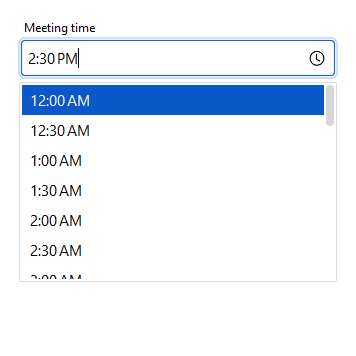
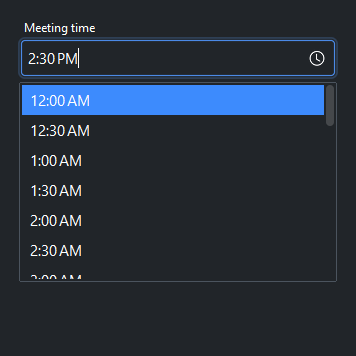
A time input field with a searchable dropdown list of time intervals. The user can type a custom time or select from the dropdown.
Usage#
A time field reads and writes a real time through field.value — or
None when empty. The user types a time ('14:30' or '2:30 PM') or picks
one from the dropdown; value_format controls only how it is displayed, and
min_time / max_time limit which times the dropdown offers. The field
starts empty — pass value= to seed a starting time.
Basic usage#
bs.TimeField(label="Select a time")
Display formats#
The value_format= parameter controls how times are displayed in the field.
Any ICU time format pattern or named preset is accepted.
now = datetime.time(14, 30)
bs.TimeField(value=now, value_format="shortTime")   # 2:30 PM
bs.TimeField(value=now, value_format="HH:mm")       # 14:30
bs.TimeField(value=now, value_format="HH:mm:ss")    # 14:30:00


Dropdown interval#
The interval= parameter sets the spacing between entries in the dropdown.
bs.TimeField(interval=15)   # every 15 minutes
bs.TimeField(interval=30)   # every 30 minutes (default)
bs.TimeField(interval=60)   # hourly


Time range constraints#
Use min_time= and max_time= to limit which times appear in the dropdown.
import datetime

bs.TimeField(
    label="Appointment time",
    message="Available 9 AM – 5 PM.",
    min_time=datetime.time(9, 0),
    max_time=datetime.time(17, 0),
    interval=30,
)
Reactive binding#
Pass a Signal via signal= to two-way bind the field’s time value to
application state. The signal carries the time object itself — not its text —
so reading it back gives you a time. Seed it with a time to set the
initial value.
from datetime import time

time_sig = bs.Signal(time(9, 0))
bs.TimeField(label="Pick a time", signal=time_sig)

# Derive a text signal for display
time_text = time_sig.map(lambda t: t.strftime("%I:%M %p") if t else "")
bs.Label(textsignal=time_text, accent="secondary")
Handling changes#
on_change() fires whenever the time value changes — whether by typing,
dropdown selection, or value= assignment.
tf = bs.TimeField(label="Start time")
tf.on_change(lambda e: print("Selected:", e.value))
Validation#
Attach rules with add_validation_rule(); they validate the field’s typed
value — a time, or None when empty. The range rule checks time
bounds with a message. This is distinct from min_time / max_time, which
limit the dropdown: a rule also catches an out-of-range time the user types,
and surfaces a message.
import datetime

field = bs.TimeField(label="Appointment")
field.add_validation_rule(
    "range",
    min=datetime.time(9, 0), max=datetime.time(17, 0),
    message="Choose a time between 9 AM and 5 PM.",
    trigger="blur",
)

is_valid = field.validate()   # run every rule on demand


Validity is reactive state. field.valid is a Signal[bool] and
field.error a Signal[str] (the current message, "" when valid) — bind
the error straight to a label and it keeps itself in sync:
bs.Label(textsignal=field.error, accent="danger") # shows and clears itself
Note
The full rule taxonomy, the range rule, and aggregating a whole form’s
validity live in the Validation guide.
States#
bs.TimeField(value=now, label="Normal")
bs.TimeField(value=now, label="Read only", read_only=True)
bs.TimeField(value=now, label="Disabled",  disabled=True)


Widget sizing#
All widgets accept self-placement kwargs via **kwargs. The parent
container determines which options apply — Column / Row parents use
the layout kwargs below, grid-based parents use grid kwargs.
Column (vertical layout)
Used inside a Column, App, or any other container with a column layout.
Children are arranged top-to-bottom, so horizontal aligns each child across
the width and grow shares the vertical space. (vertical does not apply —
the order of the children sets their top-to-bottom position.)
|
Cross-axis placement of the widget: |
|
Claim and fill a share of the leftover vertical space (the layout
direction). |
|
External spacing in pixels. Accepts an integer (equal on all
sides), a 2-tuple |
|
Horizontal external spacing (left and right). Accepts an integer
or a 2-tuple |
|
Vertical external spacing (top and bottom). Accepts an integer
or a 2-tuple |
Row (horizontal layout)
Used inside a Row or any other container with a row layout. Children are
arranged left-to-right, so vertical aligns each child across the height and
grow shares the horizontal space. (horizontal does not apply — the order
of the children sets their left-to-right position.)
|
Cross-axis placement of the widget: |
|
Claim and fill a share of the leftover horizontal space (the layout
direction). |
|
External spacing in pixels. Accepts an integer (equal on all
sides), a 2-tuple |
|
Horizontal external spacing (left and right). Accepts an integer
or a 2-tuple |
|
Vertical external spacing (top and bottom). Accepts an integer
or a 2-tuple |
Grid
Used inside a Grid container.
|
Zero-based row and column indices. |
|
Number of rows or columns to span. |
|
Horizontal placement within the grid cell: |
|
Vertical placement within the grid cell: |
|
External spacing in pixels. Accepts an integer, a 2-tuple
|
|
Horizontal external spacing. Accepts an integer or |
|
Vertical external spacing. Accepts an integer or |
See also#
DateField — date input with calendar picker
TextField — plain single-line text input
Validation — the full rule set and form-level validity
Customizing Fields — add buttons or icons inside a field
Signals — reactive binding for fields
API#
The complete reference for TimeField lives on the
Widgets API page. At a glance:
A time-input field with a searchable dropdown of time intervals. |
Full Example#
 1
 2with bs.App(title="TimeField Demo", padding=20, gap=16) as app:
 3
 4    # Basic usage
 5    bs.Label("Basic", font="heading-sm")
 6    bs.TimeField(label="Select a time")
 7
 8    # Time format presets
 9    bs.Label("Display Formats", font="heading-sm")
10    now = datetime.time(14, 30)
11    bs.TimeField(value=now, label="Short time (default)", value_format="shortTime")
12    bs.TimeField(value=now, label="24-hour",              value_format="HH:mm")
13    bs.TimeField(value=now, label="24-hour with seconds",  value_format="HH:mm:ss")
14
15    # Dropdown interval
16    bs.Label("Dropdown Interval", font="heading-sm")
17    bs.TimeField(value=now, label="15-minute intervals", interval=15)
18    bs.TimeField(value=now, label="60-minute intervals", interval=60)
19
20    # Time range constraints
21    bs.Label("Business Hours", font="heading-sm")
22    bs.TimeField(
23        value=datetime.time(9, 0),
24        label="Appointment time",
25        message="Available Monday – Friday, 9 AM – 5 PM.",
26        min_time=datetime.time(9, 0),
27        max_time=datetime.time(17, 0),
28        interval=30,
29    )
30
31    # Reactive binding — the signal carries the time object
32    bs.Label("Reactive Binding", font="heading-sm")
33    time_sig = bs.Signal(now)
34    bs.TimeField(label="Pick a time", signal=time_sig)
35    time_text = time_sig.map(lambda t: t.strftime("%I:%M %p") if t else "")
36    bs.Label(textsignal=time_text, accent="secondary")
37
38    # States
39    bs.Label("States", font="heading-sm")
40    bs.TimeField(value=now, label="Normal")
41    bs.TimeField(value=now, label="Read only", read_only=True)
42    bs.TimeField(value=now, label="Disabled",  disabled=True)
43
44    # Handling changes
45    bs.Label("Handling Changes", font="heading-sm")
46    last = bs.Signal("(none)")
47    tf = bs.TimeField(label="Choose a time")
48    tf.on_change(lambda e: last.set(str(tf.value)))
49    bs.Label(textsignal=last, accent="secondary")
50
51    # Validation
52    bs.Label("Validation", font="heading-sm")
53    validated = bs.TimeField(label="Required time", required=True)
54    with bs.Row(gap=8):
55        bs.Button("Validate", on_click=lambda: validated.validate())
56
57app.run()