

Slider#
A single-handle track for selecting a numeric value within a range.
Usage#
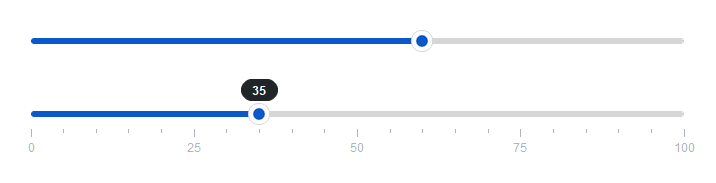
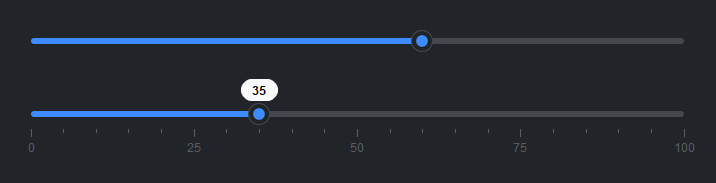
A slider holds a numeric value within a min_value/max_value range,
always clamped to the bounds. The decision you make is when to react:
on_change fires continuously as the handle moves, while on_commit fires
once on release — reach for on_commit when the work per update is expensive.
Basic#
bs.Slider()
bs.Slider(50, min_value=0, max_value=100)
Accent colors#
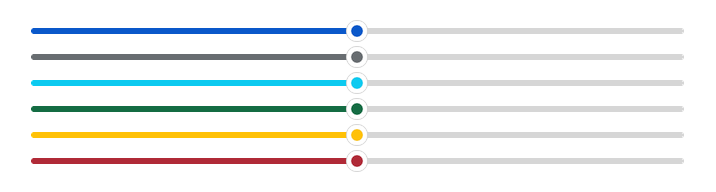
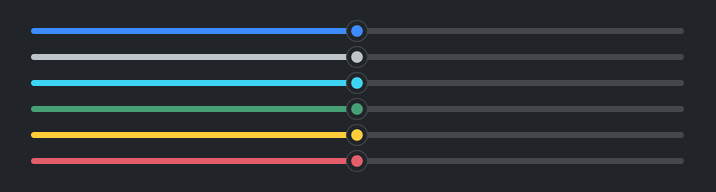
bs.Slider(50, accent="primary")
bs.Slider(50, accent="secondary")
bs.Slider(50, accent="info")
bs.Slider(50, accent="success")
bs.Slider(50, accent="warning")
bs.Slider(50, accent="danger")
Value badge#
Set show_value=True to display a floating badge with the current value
above the handle.
bs.Slider(50, show_value=True)


Min / max labels#
Set show_minmax=True to display the minimum and maximum values at the
track ends.
bs.Slider(50, show_minmax=True)


Note
When tick_step is set with labels, the range ends are already labeled —
show_minmax is mainly for a slider without tick marks.
Tick marks#
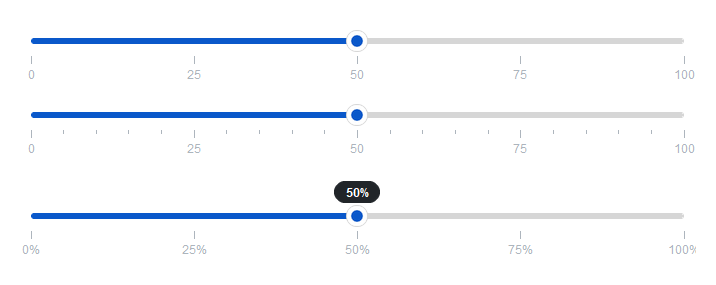
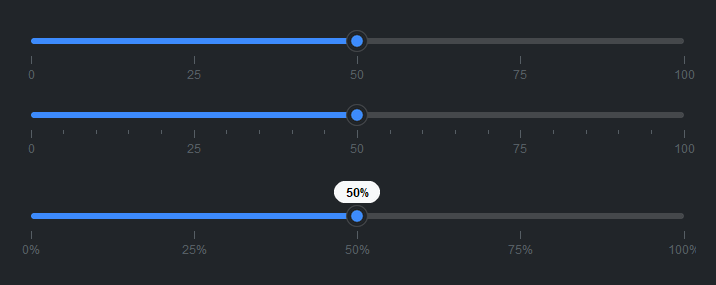
Use tick_step= to add major tick marks. minor_ticks= adds
subdivisions between them. tick_labels=False hides the numeric labels.
tick_format= controls how tick and badge labels are formatted.
bs.Slider(50, tick_step=25)
bs.Slider(50, tick_step=25, minor_ticks=4)
bs.Slider(0.5, min_value=0, max_value=1, tick_step=0.25, tick_format="{:.0%}")
Note
tick_step only draws the marks — the value still moves continuously.
To make the slider snap to those increments, use step= (see
Snapping to steps).
Snapping to steps#
Set step= to constrain the value to discrete increments. Click and drag
values snap to the nearest multiple of step (measured from min_value),
and the arrow keys move by step. It is independent of tick_step — set
both for a stepped slider with matching marks, or step alone to snap without
drawing ticks.
# Only 0, 5, 10, … 100 — with ticks drawn at the same increments
bs.Slider(50, min_value=0, max_value=100, step=5, tick_step=5)
When the range is not an even multiple of step, the maximum stays reachable.
Reactive binding#
Bind a Signal[float] with signal=. The slider and signal stay in sync.
volume = bs.Signal(50.0)
bs.Slider(signal=volume)
volume.subscribe(lambda v: update_volume(v))
Events#
on_change fires continuously as the handle moves; on_commit fires once
when the handle is released or moved by keyboard. Reach for on_commit when
the work behind the slider is expensive — a network call, a recompute, a redraw.
s = bs.Slider(50, min_value=0, max_value=100)

# Fires continuously during a drag — keep this cheap
s.on_change(lambda e: preview(e.value))

# Fires once, on release or keyboard commit
s.on_commit(lambda e: apply(e.value))

# As a Stream
s.on_change().debounce(150).listen(lambda e: save(e.value))
The handler receives a SliderEvent (on_change)
or SliderCommitEvent (on_commit); event.value
holds the current value.
Keyboard#
When focused, the slider responds to the arrow keys (±1, or ±``step`` when
step is set), Shift + arrow (a larger jump), and Home / End
(minimum / maximum). Every keyboard change also emits on_commit.
Disabled#
bs.Slider(60)
bs.Slider(60, disabled=True)


Widget sizing#
All widgets accept self-placement kwargs via **kwargs. The parent
container determines which options apply — Column / Row parents use
the layout kwargs below, grid-based parents use grid kwargs.
Column (vertical layout)
Used inside a Column, App, or any other container with a column layout.
Children are arranged top-to-bottom, so horizontal aligns each child across
the width and grow shares the vertical space. (vertical does not apply —
the order of the children sets their top-to-bottom position.)
|
Cross-axis placement of the widget: |
|
Claim and fill a share of the leftover vertical space (the layout
direction). |
|
External spacing in pixels. Accepts an integer (equal on all
sides), a 2-tuple |
|
Horizontal external spacing (left and right). Accepts an integer
or a 2-tuple |
|
Vertical external spacing (top and bottom). Accepts an integer
or a 2-tuple |
Row (horizontal layout)
Used inside a Row or any other container with a row layout. Children are
arranged left-to-right, so vertical aligns each child across the height and
grow shares the horizontal space. (horizontal does not apply — the order
of the children sets their left-to-right position.)
|
Cross-axis placement of the widget: |
|
Claim and fill a share of the leftover horizontal space (the layout
direction). |
|
External spacing in pixels. Accepts an integer (equal on all
sides), a 2-tuple |
|
Horizontal external spacing (left and right). Accepts an integer
or a 2-tuple |
|
Vertical external spacing (top and bottom). Accepts an integer
or a 2-tuple |
Grid
Used inside a Grid container.
|
Zero-based row and column indices. |
|
Number of rows or columns to span. |
|
Horizontal placement within the grid cell: |
|
Vertical placement within the grid cell: |
|
External spacing in pixels. Accepts an integer, a 2-tuple
|
|
Horizontal external spacing. Accepts an integer or |
|
Vertical external spacing. Accepts an integer or |
See also#
RangeSlider — two-handle range selection
NumberField — numeric input with typed entry
API#
The complete reference for Slider lives on the
Widgets API page. At a glance:
A single-handle slider for selecting a numeric value within a range. |
Full Example#
 1
 2with bs.App(title="Slider Demo", padding=20, gap=16, min_size=(400, 1)) as app:
 3
 4    # Basic
 5    bs.Label("Basic", font="heading-sm")
 6    bs.Slider(horizontal="stretch")
 7
 8    # Accent colors
 9    bs.Label("Accent Colors", font="heading-sm")
10    with bs.Column(gap=6, horizontal="stretch", horizontal_items="stretch"):
11        for accent in ("primary", "secondary", "info", "success", "warning", "danger"):
12            bs.Slider(50, accent=accent)
13
14    # Value badge
15    bs.Label("Value Badge", font="heading-sm")
16    bs.Slider(50, show_value=True, horizontal="stretch")
17
18    # Min / max labels
19    bs.Label("Min / Max Labels", font="heading-sm")
20    bs.Slider(50, show_minmax=True, horizontal="stretch")
21
22    # Tick marks
23    bs.Label("Tick Marks", font="heading-sm")
24    bs.Slider(50, tick_step=25, horizontal="stretch")
25    bs.Slider(50, tick_step=25, minor_ticks=4, horizontal="stretch")
26    bs.Slider(50, tick_step=25, show_value=True, show_minmax=True, horizontal="stretch")
27
28    # Custom tick format
29    bs.Label("Custom Tick Format", font="heading-sm")
30    bs.Slider(
31        0.5,
32        min_value=0.0,
33        max_value=1.0,
34        tick_step=0.25,
35        tick_format="{:.0%}",
36        show_value=True,
37        horizontal="stretch",
38    )
39
40    # Step snapping (only 0, 5, 10, … 100)
41    bs.Label("Step Snapping", font="heading-sm")
42    bs.Slider(50, step=5, tick_step=5, horizontal="stretch")
43
44    # Disabled
45    bs.Label("Disabled", font="heading-sm")
46    bs.Slider(30, disabled=True, horizontal="stretch")
47
48app.run()